Bringing order to the Oral History Recordings
As part of gaining my AMA (Associateship of the Museums Association) I was required to carry out a six month Work Based Project. The two main aims of the project were :
- Effect a positive change in the way I work
- Effectively manage myself, my time and resources
My project title was “Widening Access: Oral Histories at Brent Museum and Archives”. I noticed when I first started working for Brent Museum and Archives there was quite a large Oral History collection of, over 400 recordings, and that 99% of it did not seem to be well documented.
Why this project?
My manager and I decided this would be a useful part of the collection to sort out for a number of reasons:
- Some of the formats that the oral histories were in were becoming obsolete and if the information on them was not removed soon then there was a risk it would never be accessible
- Oral histories are a powerful tool for opening up the past. Used sensitively in exhibitions they can really bring to life what it was like at a certain period of time. This makes them useful to all researchers and to Brent Museum and Archives for future exhibitions.
- Lastly within the last 8 months we have carried out one new oral history project and been approached by 2 other people who want to/are carrying out oral history projects in Brent. This is clearly the type of project that is popular and we need to be able to provide a safe accessible place for these new oral histories.
When I began the project the oral histories were disorganized, poorly documented, needed repackaging and most importantly they needed to become more accessible to the public. You can see from some of these images below the sort of state many of the oral history recordings were in.
-

- MiniDisk format difficult to listen to
-

- Yes those are floppy discs!
-
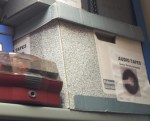
- Non archive packaging needed replacing
-
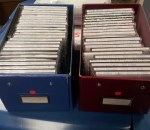
- More recent projects better cared for but not in archive boxes and not digitised.
-

- ‘Misc’ boxes of cassettes not well cared for.
-
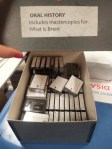
- Small format tapes difficult to listen to
Aims
The main aims of the project were to:
- Create a spreadsheet of all of the oral histories
- Place the oral histories on Adlib (our online database) so they are accessible to the public
- Identify oral histories which require transcribing
- Identify oral histories which lack permission forms from donors
- Create a document outlining the cost of digitizing the oral histories and creating backups
- Create a document outlining best practice for oral history storage, cataloguing and documentation at Brent Museum and Archives.
This did not sound too complicated to me but doing this alongside planning for the new museum due to open this summer was no easy task.
The beginning…
To start with I roughly assessed what we had to see if there was anything horrible hiding in the bottom of a box which needed urgent attention! Luckily all of the oral histories seemed to be in a stable state. I also had to scour the computer to find any digital files linked to the oral histories. These turned up in lots of strange places. A lot of these digital files were of transcripts and of images of the participants or of exhibition which the oral histories were linked to. You may have also noticed in one of the images above some floppy discs so I also had to purchase a floppy disc drive to access this information which mainly consisted of transcripts from some of the older recordings. Once I had all of the oral histories and digital files one place I could start putting together a spreadsheet of this material. I was not the first person to try to bring order to the oral histories. A number of people had tried in the past and so I was also to merge a number of incomplete spreadsheets as a starting point.
Further Research
I then carried out research into best practice in looking after oral histories and how to catalogue them. this research proved to be very frustrating. I could find lots of information about how to carry out oral history interviews, what questions to ask, how to choose people to interview, but there was practically no information about how to deal with an old collection of oral history in a small museum. I therefore emailed the British Library to ask for guidance. They were incredibly helpful. They provided lots of links to on-line resources and confirmed my suspicions that there is no international standard or agreed methodology for cataloguing oral histories but there is ‘best practice’. I decided when placing the oral histories onto our on-line database I would bring together the best practice used in the British Library with the archiving ISAD(G) standards. this means where possible that the key fields used to record the oral histories are:
• Reference code
• Title
• Name of Creator
• Dates of Creation
• Extent of the Unit of Description
• Level of description
• Speaker
• Location of recording
• Duration
• Copyright:
• Access restrictions
• Interview summary
• Recording format
The Cataloguing
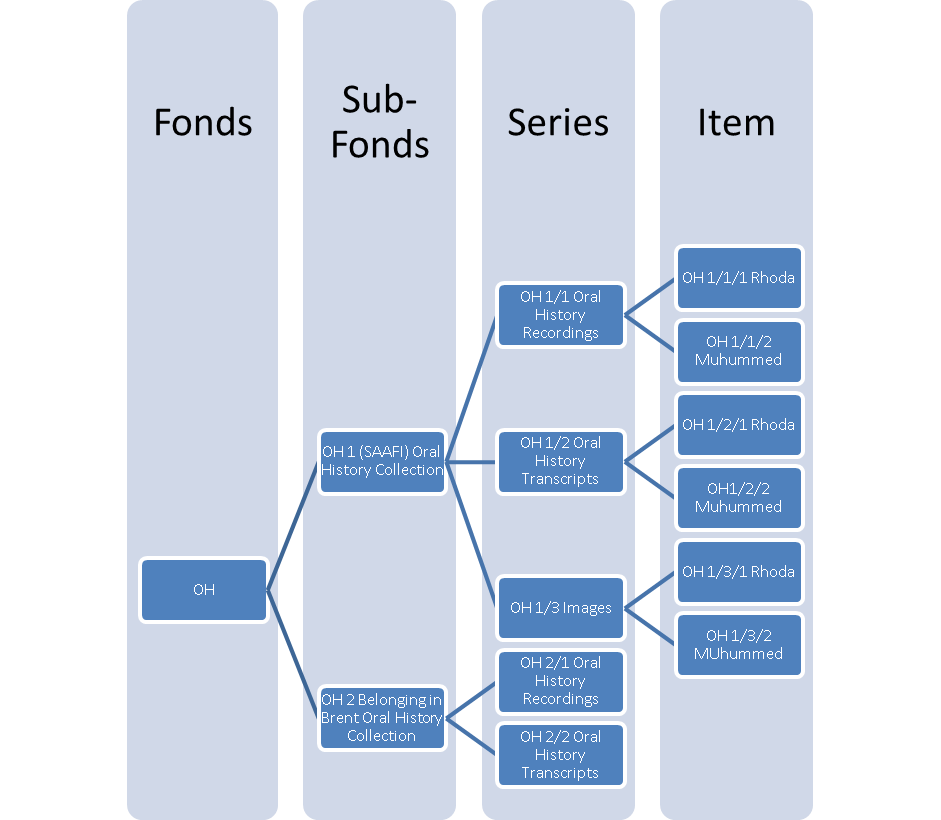
Placing the oral histories onto our on-line database (Adlib) was a lot more time-consuming that I first realized. Not only was I dealing with the Oral History recordings themselves but they often had other material that was associated with them. This material needed to remain linked on the database to show that it was all linked up in the same project. As you can see from the example below where the SAAFI project was broken down into three series: The Oral History Recordings, Transcripts and Images.
The Future: Transcripts, permissions and digitizing
By the end of the project 384 oral histories were catalogued into 18 collections onto the Adlib database. Unfortunately due to a technical glitch this information is not accessible at the moment but the IT department at Brent Council is working on fixing this problem.
I found that 183 oral histories need transcribing. Professionally this is estimated to cost over £8000. However it is thought that perhaps this is a task which volunteers may be interested in carrying out once we are settled in our new building.
Near the end of the project budget was found to digitize 50 recordings which were on old magnetic reel to reel tapes. 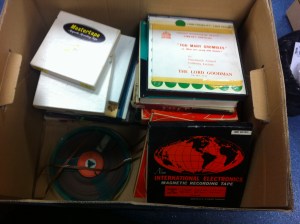
The estimated cost of digitizing the other 246 oral histories was calculated at £1476. This is something we would like to do in the future, budget willing, but we will need to think long and hard about where the digital recordings will sit within the Brent Council computer system as they will take up a lot of digital space.
I was able to identify 2 broken tapes and also a small number of tapes in formats we could not play on our current equipment.
All of the oral history recordings were repackaged into acid free packaging and placed in the archive store where they belonged.
In the long run, once the on-line database is updated, it is hoped people will carry out research into our oral histories and that they will be used a lot more by people working in the museum in temporary exhibitions and learning and outreach.
Written by Emma Traherne, Heritage Officer.
 brentmuseumandarchives
 Colin C.
 Emir Ghariani
Thank you, Emma. Your work on this will be very useful.
I know that several of us (staff and volunteers) did a number of oral history recordings of the memories of people who had lived in local pre-fab homes after the Second World War, as part of a “Pre-fabs Project” in 2011. Staff changes and other priorities meant that the pre-fabs information was never fully pulled together, but that is something I would like to work on in future. Have you got “sub-fonds” or “series” for the Pre-fabs oral history items?
Philip.
Hi Philip. Thanks for your comment. The Pre-fab information was all in a very good state when I found it. It was the first one I catalogued. The sub-fond is OH/1 and they are catalogued to item level. However with so many oral histories to get on the system I wasn’t able to include as much information onto the records as I would have liked. Therefore there is some more work which can be done in the future to add information to the records to make them even more ‘searchable’ to researchers.