The Lions of Wembley
A visitor to The British Empire Exhibition in 1924 would have been overwhelmed by the sights and sounds of such a vast display. They would have experienced countries and cultures which they were unlikely to have had the opportunity to visit. They may also have noticed a number of lions – with the symbolic animal appearing on everything from tickets, programmes and stamps to the grand statues situated outside the pavilions, and on the souvenirs available for visitors to take home.
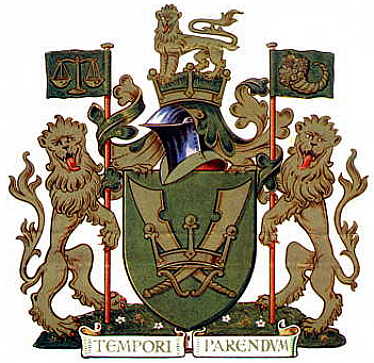
The Wembley coat of arms © Heraldry of the World 1996, Ralf Hartemink (www.ngw.nl)
The lion was a symbol of the British Empire, and was used ubiquitously in the exhibition in a variety of different forms. This did however come from a very long tradition, with the lion being used as a symbol of England and Englishness, appearing in heraldry from the late 12th century onwards. The lion continues to form part of the symbolic heraldry of England to this day, and indeed has appeared on the historic coats of arms for both Wembley and Brent.
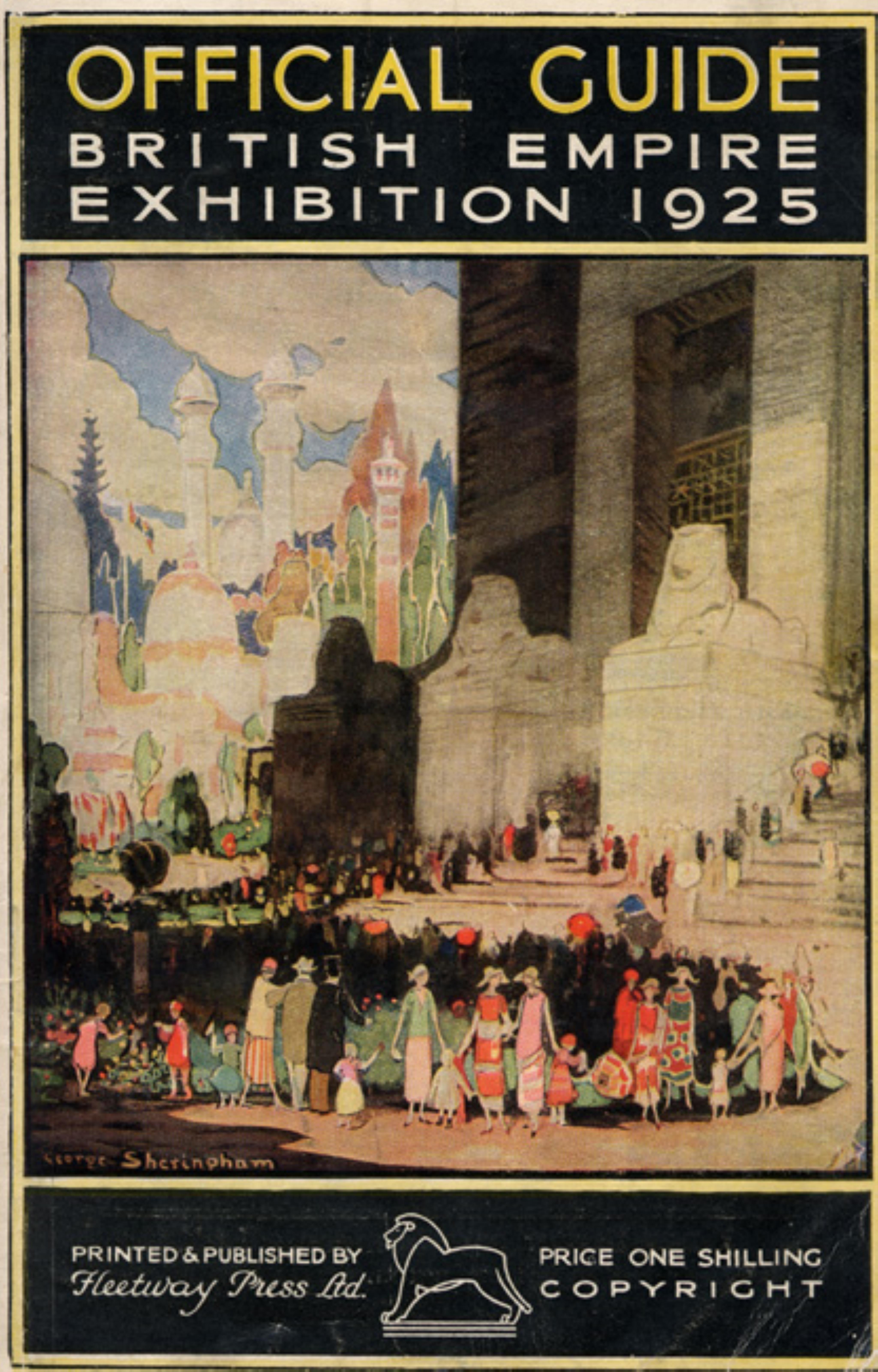
The Official Guide to the British Empire Exhibition, featuring the Art Deco Lion designed by J.C. Herrick © Brent Museum and Archives
The ‘Wembley Lion’ was the official symbol of the British Empire Exhibition and took a variety of forms. One prominent design was that of an Art Deco lion that appeared on many items including the official guide, tickets for the opening ceremony, medals and a Lipton’s tea caddy – one of which can be seen in our exhibition at the Civic Centre. It was not, however, the only lion used. The exhibition was also marked by the issue of a commemorative stamp, with artists being asked to submit designs
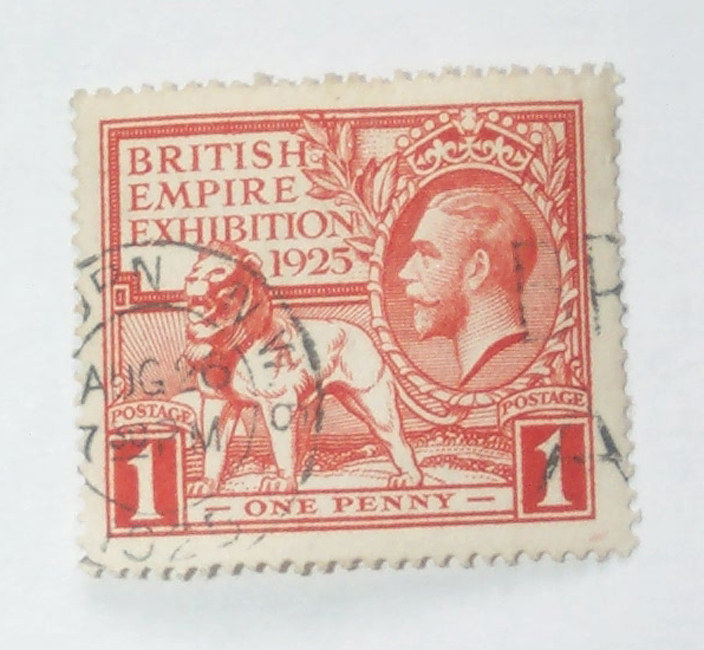
1d stamp designed by Harold Nelson © Brent Museum and Archives.
symbolic of the British Empire. In all, eight artists were invited to submit designs. Five were received, and the lion chosen was designed by Harold Nelson, featuring a rising sun in the background. The stamp was reissued in 1925, and a variety of stationery was also produced, imprinted with the same design.
The lion also featured prominently in the architectural design of the Exhibition. Famously, six lion sculptures appeared outside the Government Pavilion – giving a nod to the Art Deco influences of the day, but unlike the stamps or the Art Deco design, these lions were seated. Lions were also designed in-keeping with the cultural style and significance to the countries represented in the different pavilions – for example the fearsome lions or ‘chinthes’ outside the Burmese Pavilion followed on from a long
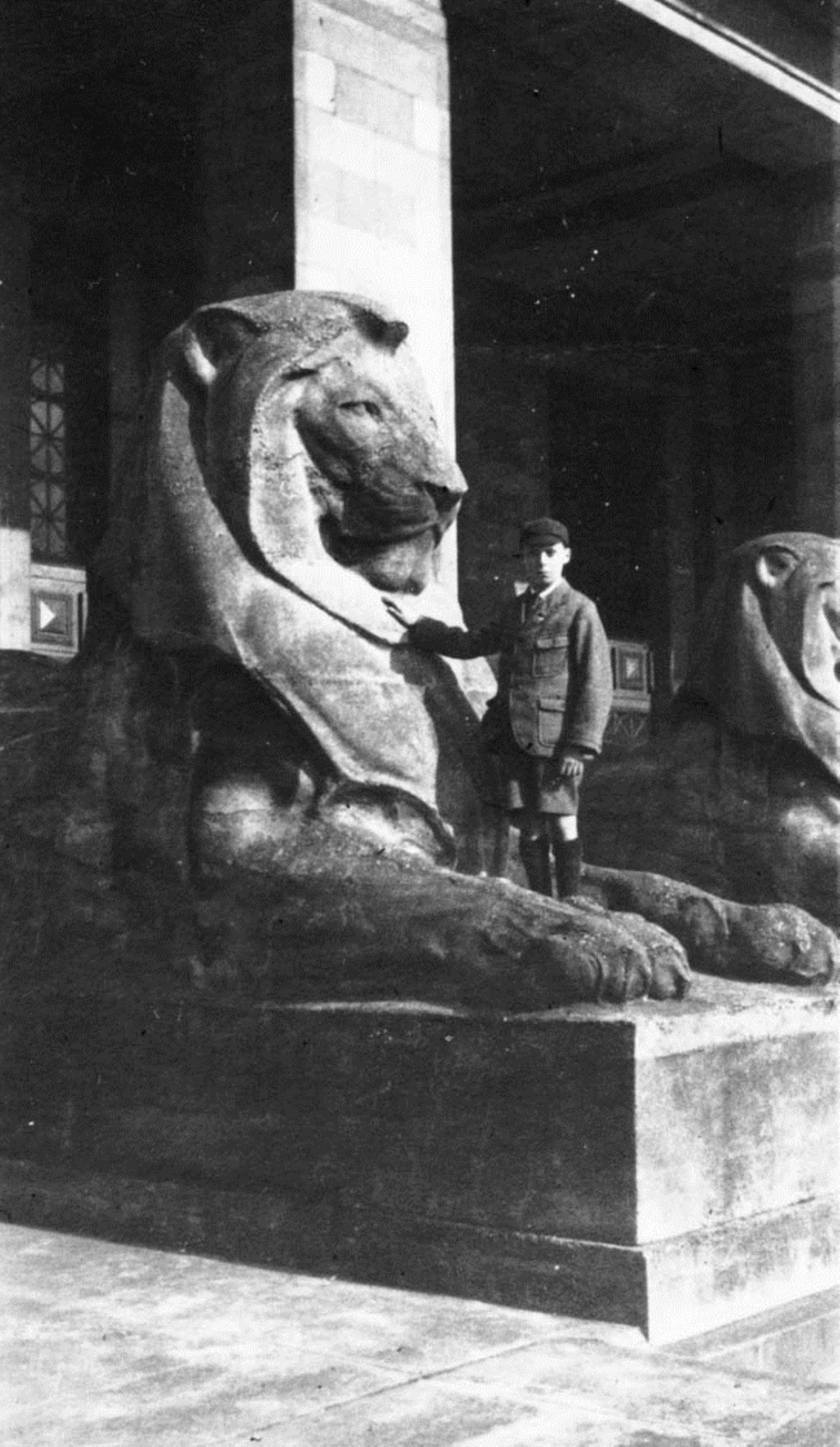
Small boy standing by one of the lions of the British Government Pavilion © Brent Museum and Archives.
tradition in Burmese and south-east Asian mythology whereby these lion-like creatures can be seen guarding the entrances of pagodas and temples. Thus the lion symbol arguably not only provided continuity within the context of the exhibition, but also provided a link to the rich cultural traditions of the countries being represented.

The lion designed by Percy Metcalfe for the Palace of Industry © Brent Museum and Archives.
Another rather more aggressive looking lion was designed by Percy Metcalfe. Sir Lawrence Weaver was appointed to plan the exhibits to be shown at the Exhibition and, in a similar fashion to the commemorative stamps, the decision was taken to produce two commemorative medals – one of them being a souvenir to be sold to the public. Ten designs were submitted, but the advisory panel chose Metcalfe’s design and he began work on a symbol that reflected the modern British Empire. The result was the lion seen here, which Metcalfe modelled for the Palace of Industry, and the lion was reproduced in a variety of different forms and sizes by Ashstead Potteries.
These are by no means all of the lions connected to the British Empire Exhibition that our intrepid explorer would have discovered on visiting Wembley in 1924 or 1925. The range and diversity was something we took into consideration when planning our own exhibition and designing an appropriate symbol. The history of the British Empire is not an easy subject to discuss, and the work that Brent Museum and Archives carried out with groups of young people for the exhibition at Brent Civic Centre threw into stark contrast the ideas surrounding Empire in 1924, compared to what the modern inhabitants of Wembley might feel about the legacy of the British Empire today. What emerged from this work was a very clear idea of the need to move on from the imperial past and to commemorate, not celebrate, the British Empire Exhibition. The view was that we should acknowledge the importance and sheer scale of the achievement in putting on such a spectacular show, whilst moving towards an understanding of the diversity of the communities that exist within Wembley today. As one visitor to the exhibition in the Civic Centre eloquently put it “If we, including Wembley, are to think through the shame of our past to become a world place now, we have to recognise these differences in perception and perhaps eventually to own what was magnificent about the exhibition in a different way”. The mottos of the historic Wembley and Brent coats of arms – ‘Tempori Parnedum’ (we must move with the times) and ‘Forward Together’ respectively – have never seemed so apt.
![BEE-Logo[1]](https://brentpeoplesmuseum.org/wp-content/uploads/2014/07/bee-logo1.jpg)
The modern logo designed for the exhibition ‘The Lion Roars: The World in Wembley’ © Brent Museum and Archives.
Sadly, it is no longer possible to see these lions around Wembley today – although in the near future one of the lion head corbels from the Palace of Industry will go on permanent display on Wembley Hill Road, providing a lasting reminder of the many lions that would have graced the plains of Wembley Park in 1924.
 brentmuseumandarchives
 Colin C.
 Emir Ghariani
As the local historian who, with support from fellow members of Wembley History Society and from the Exhibition Study Group has been campaigning, and working with Brent Council, to get one of the lion head corbels from the demolished Palace of Industry building put on permanent public display, I am delighted to share the news with you that this “Wembley Lion” will be unveiled next Monday lunchtime, 28 July, at 12.15pm.
Please join us there if you can (on the open space in Wembley Hill Road, opposite York House and near the London Designer Outlet), to celebrate this physical reminder of the British Empire Exhibition, which ninety years ago brought people to Wembley from all over the world ‘to get to know one another better’.
Even if you cannot attend the unveiling, please take the chance to visit the “Wembley Lion” this summer – the grassy open space, with some seats and some shady trees, is a lovely spot for a picnic, and as Wembley is now a place with both residents and visitors from around the world, you can use the lion as the starting point for a conversation with a stranger, ‘to get to know one another better’. What better legacy from the British Empire Exhibition!
Overall, an interesting article about Wembley lions, and nicely illustrated.
It fails, however, to tackle two significant points about the lion design used as the logo for the current Brent Civic Centre exhibition.
Firstly, the lion logo bears very little, if any, resemblance to any of the four 1920s Exhibition lions submitted to the designer who produced it. Look up the four relevant lions, by, as the article says, Herrick, Metcalfe, Clemens and Harold Nelson (only two of them are illustrated in the article), and you will see that they are all relatively modern (for their period), yet clearly early twentienth century in feel (though strictly speaking not Art Deco, since the term would not be coined until the Exposition Internationale des Arts Décoratifs et Industriels Modernes, which only opened in April 1925). None of the four source lions is rampant, none of them has a naturalistic mane, and they all look a great deal better fed than the current lion logo, which has visible ribs. Its only real connection with them is being a lion, which makes one wonder why they were shown to the designer at all – the designer, after all, presumably already knew what a lion looked like. The Brent logo lion’s face actually bears a far closer resemblance to the Percy Metcalfe lion for the Palace of Industry, illustrated in the article, than it does to any of the lions in the designer’s brief!
It’s also worth pointing out that the four source lions were modern for their period, whereas the lion logo is not particularly modern for 2014. Indeed I believe it was mistakenly assumed to be a Wembley Lions speedway team lion logo, from the late 1940s or 1950s, by one local historian who immediately saw that it had no connection with the 1924-5 Exhibition.
This brings us to the second point, that if a totally made-up lion design was chosen to be the emblem of Brent’s Civic Centre British Empire Exhibition exhibition, surely the public should have been told this somewhere. I cannot imagine the majority of visitors, seeing it, immediately thought ‘oh yes, of course, that’s a modern lion design intentionally separating itself from the lions of the Exhibition itself whilst acknowledging “both the heraldic traditions of the lion as a symbol of England and the Empire’ and ‘the iconic past of Wembley and the diversity of its multicultural community today’.” I’d imagine most of them thought it was a lion from the 1920s Exhibition, and went away misled, while those visitors who knew enough about the British Empire Exhibition went away thinking (wrongly, as it turns out) that Brent Heritage had selected an obscure illustration thinking it was from the British Empire Exhibition when it was not. A simple observation somewhere that the lion design was totally made up would have made life a lot easier for all concerned. Now, whenever Brent Heritage creates a logo, everyone will have to scurry for the reference books to see whether or not it bears any real connection to the subject matter and period of the exhibition concerned, or whether it is just a modern design made up to look impressive. Shame, really.
Oh, a further thought. What exactly is an ‘iconic past’? And what is an un-iconic one? And, indeed, can a past be iconic at all? Sometimes, these overused heritage buzzwords are best avoided…
With reference to the photo of Percy Metcalfe’s Lion I do not think this is the Lion of Industry on the plinth at the entrance to the Palace of Industry because the pose and design of the lion is very different. My grandfather, Percy Metcalfe, modelled the lion illustrated for the Cenotaph in Durban, South Africa for which he also modelled the sculpture of the deceased soldier and can be seen on the website. I would be interested to know if the lion shown did appear at Wembley in any form. I have a picture of the Lion of Industry being modelled by Percy Metcalfe if you are interested.