War and Remembrance
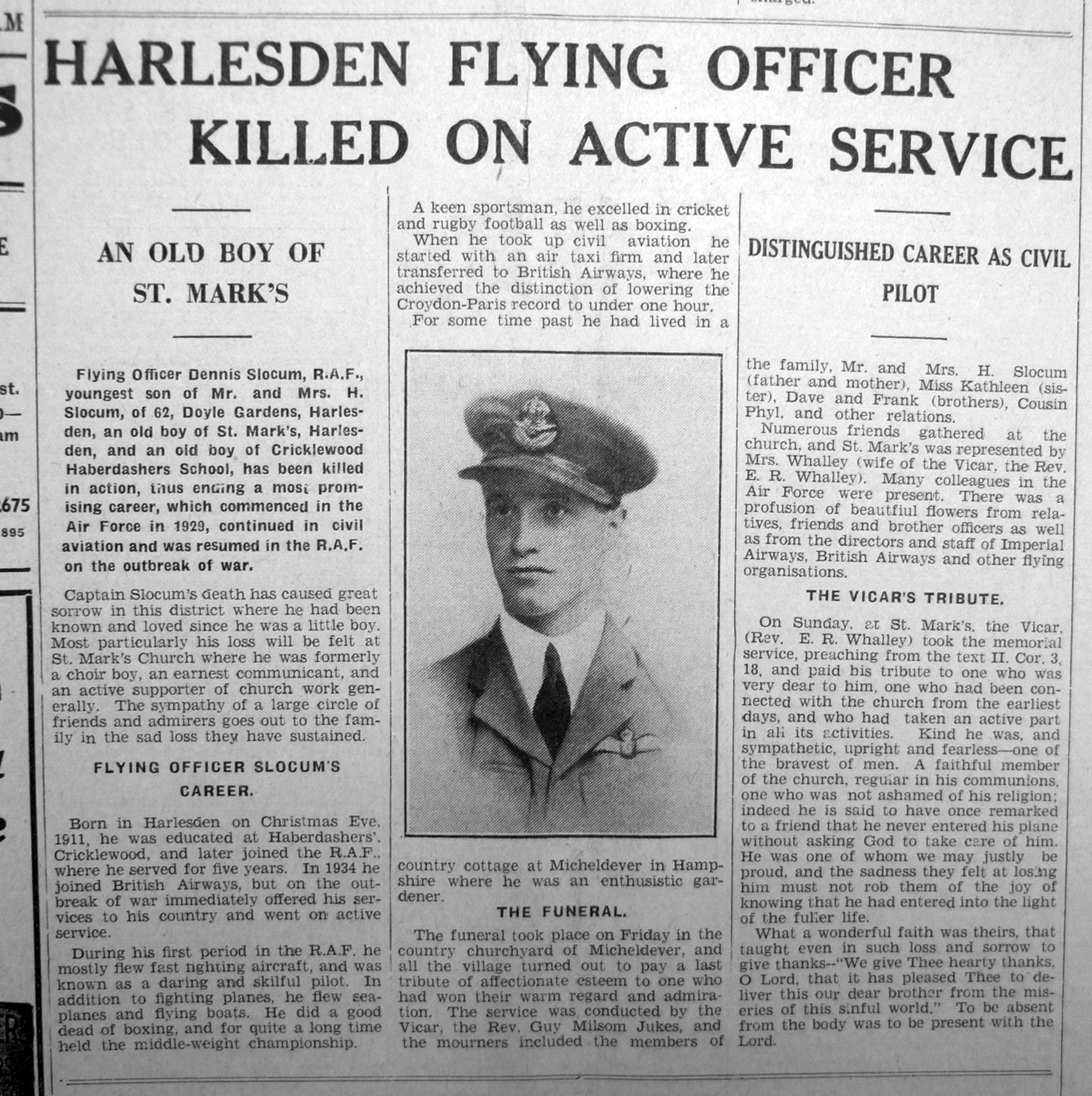
Sydney Dennis Slocum obituary, Willesden Chronicle, 15th March 1940. Slocum served in 224 Squadron, flying American-built Lockheed Hudsons over the North Sea from Leuchars in Scotland
Brent Archives’ latest display on the felt screens outside the Search Room is on a remembrance theme. It consists entirely of obituaries of local people killed in the Second World War, taken from the Wembley and Willesden papers. We have entitled it War and Remembrance, also the title of a novel by the US novelist Herman Wouk (b. 1915), best known for The Caine Mutiny (1951).
The United Kingdom suffered 326,000 military and 62,000 civilian casualties in the Second World War. This was significantly lower than the losses Britain suffered, in a shorter period of time, in the First World War, but it still put Britain fourth among the Allied powers in terms of military dead, after the Soviet Union, China and Poland, and eighth in terms of all dead, after the Soviet Union, China, Poland, Yugoslavia, France (a position which makes the Vichy regime’s claims to have protected French civilians from the occupiers look pretty hollow), Greece and Czechoslovakia.
Our display hopefully brings home the scale of that loss, as reported in the Willesden Chronicle and Wembley Observer.
Unlike the practice during the First World War, the papers did not publish actual casualty lists, but they did publish numerous stories about men at the front. As in the First World War, where the casualty lists could be interspersed with lists of wounded and other men, obituaries in the Second World War were mixed up with stories of woundings, promotions and interesting postings and events. The families had already been informed, but the appearance of a photograph of a friend or former colleague on the front page must have been a heart-stopping moment for many, even if the story simply revealed that they had met their brother in Tripoli…
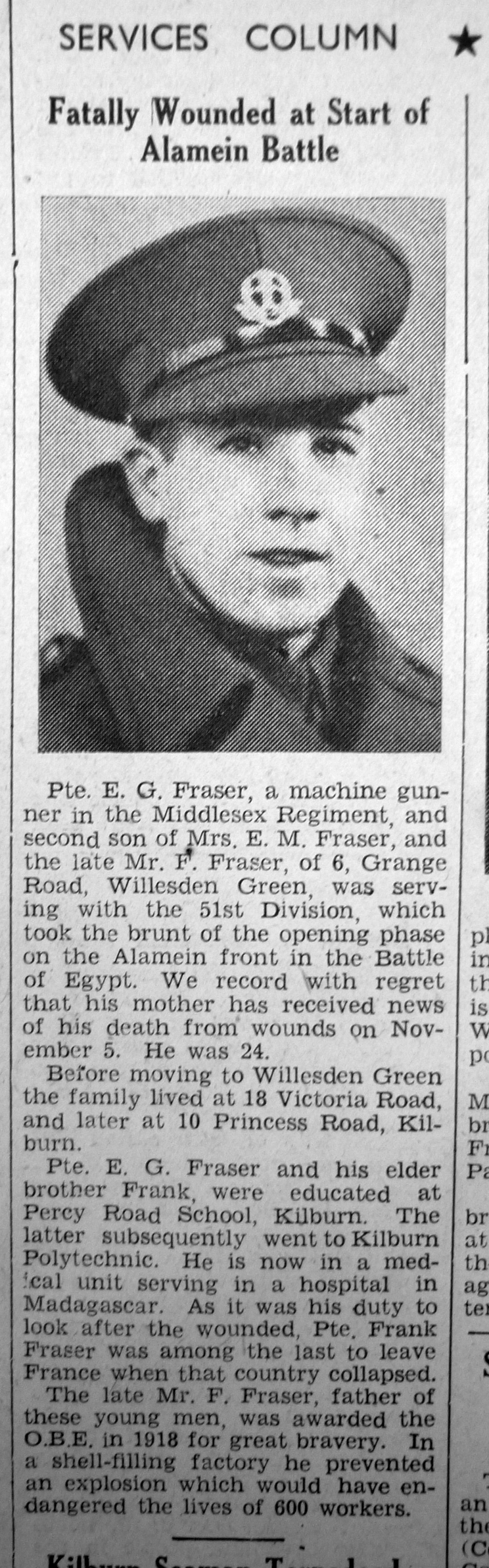
Willesden Chronicle, 4th December 1942. We can find no record of a Fraser in the Middlesex Regiment killed in the Second Battle of El Alamein, so any information will be gratefully received
Our selection is in no way a representative sample. We have tried to cover as many branches of service and fronts as possible, but in doing that we may actually have made the selection unrepresentative. Other factors have also intruded, such as stories being selected because of their pathos or general interest, or because of the presence of photographs. During the First World War the Wembley paper, then the Harrow Observer, tended to make far more use of photographs than the Willesden Chronicle. By 1939 this situation had been reversed, and there are far fewer photos relating to Wembley fatalities.
Despite the caveat that this is not a scientifically selected sample, a few points are still worth making. There are no merchant seamen, presumably because Brent is inland. The first military deaths reported are the result of a road accident. Shockingly, the ony female service fatality we found was raped and murdered by one of her male comrades.
There are relatively few army fatalities in 1941, and one can really see how the RAF, and notably Bomber Command, was Britain’s main weapon against Germany in this period.
As the war turns in the Allies favour the death rate rises noticeably, with far more deaths from El Alamein onwards. The cost of victories in Tunisia, Italy and Normandy is all too plain to see, as is the cost of failure at Arnhem, while RAF losses of course continued.
Despite the popular, and erroneous, modern tendency to think that the war was pretty much over after the failure of the Battle of the Bulge, deaths continue well into 1945. A sailor from Stonebridge was killed when HMS Bluebell (a ‘Flower’ class corvette, like the fictional Compass Rose in Nicholas Monsarrat’s The Cruel Sea) was sunk by U-711 off Murmansk on 17th February 1945. She sank within 30 seconds. Of 86 crew, only one man survived.
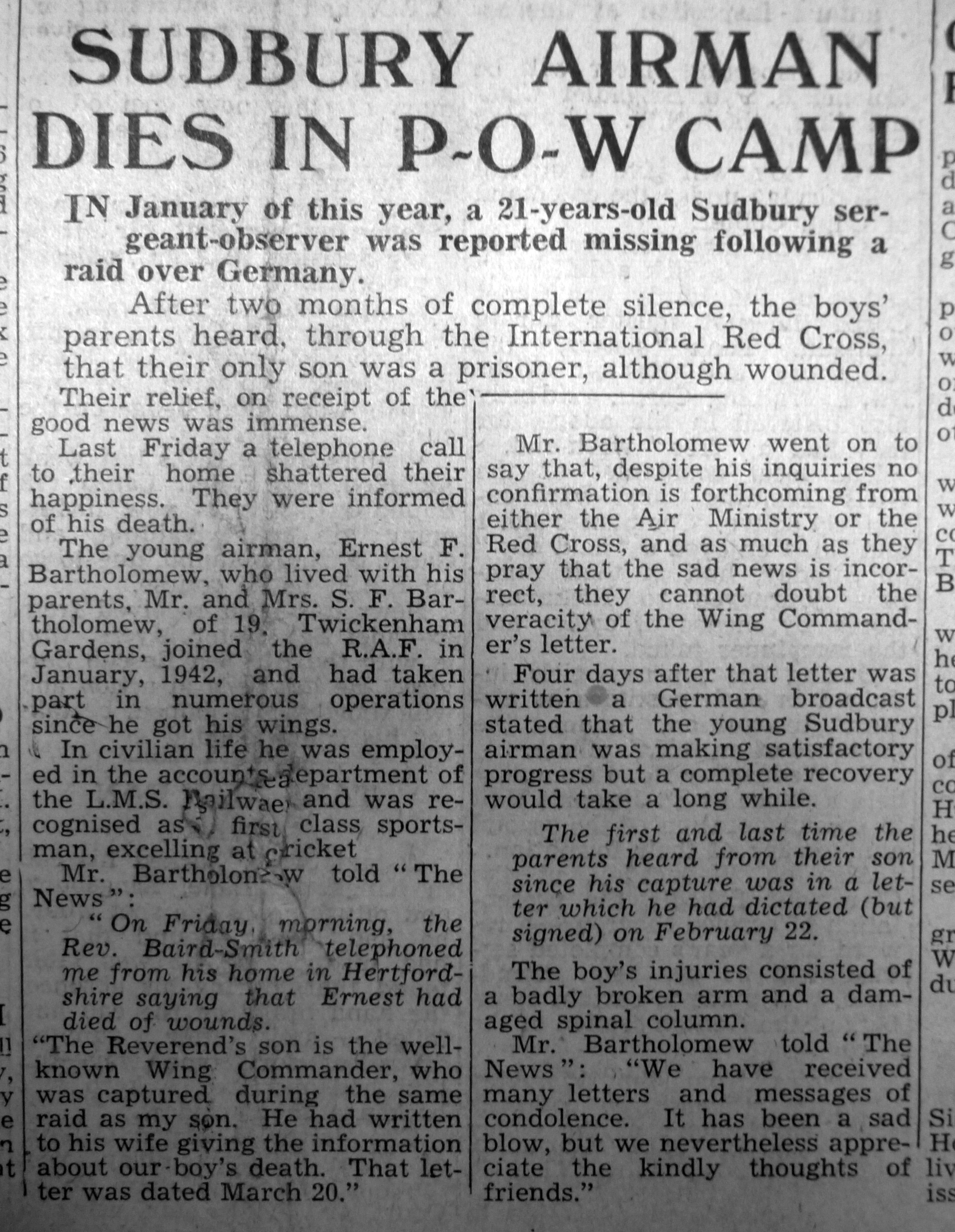
Wembley News, 2nd June 1944. Bartholomew, of 7 Squadron, Bomber Command, died on 27th January 1944. His Lancaster bomber had been shot down near Döberitz, just west of Berlin, on 20th January. Four of the crew were killed instantly (three of these have no known grave) and two survived the war. It is worth noting that the German treatment of Bartholomew appears to have been exemplary. The Luftwaffe treated captured British and American airmen very well.
Other than the actual newspaper reports, all additional information (like the facts about HMS Bluebell above) was gleaned from the Internet. This was simply a matter of time management, rather than deliberate proselytising nerdiness. The Internet is rarely an adequate research tool on its own, but for our purposes here it proved exceptionally useful, allowing us to identify squadrons, ships and even in some cases more detail about the circumstances of individuals’ deaths.
Much information came from the excellent Commonwealth War Graves Commission website, and using this information we were then able to discover more elsewhere. None of this would have been possible in the pre-Internet age.
A smaller version of the display, containing most of the Wembley material and some of the Willesden material, can be seen at Town Hall Library.
Posted by Malcolm
 brentmuseumandarchives
 Colin C.
 Emir Ghariani