When Willesden helped rebuild Stalingrad – a story for Victory Day

The ribbon of St George, originally associated with a Tsarist medal, but today connected with the Second World War through its use suspending the wartime Order of Glory and the Medal for Victory over Germany
As readers will know, 8th May marks the 67th anniversary of the end of Second World War in Europe. In Russia, and many other states of the former Soviet Union, however, Victory Day is 9th May. The approach of 9th May reminds me that, a few years ago, Brent Archives received a request from the Museum-Panorama in Volgograd, formerly Stalingrad.
During the War there was great popular support in Britain for the Soviet Union. Given the military situation the British Government naturally encouraged this, but the support was largely spontaneous. It was of course especially strong among the Left, and workers in general, but to some extent it transcended class and political barriers.
Talks and meetings about the USSR were held in both Willesden and Wembley. More importantly, money was raised to help the Soviet war effort. In May 1943, the film The Story of Stalingrad was shown in local cinemas. Meanwhile, Conservative Wembley held an ‘Aid to Russia’ ball at Wembley Town Hall.
Then, on 24th August there was an ‘Aid to Russia’ flag day, where 500 Willesden people attended a fund-raising concert at the Gladstone Civil Defence Depot.
From 22nd June 1943, 300 English towns and villages sent money to the Stalingrad Hospital Fund. This was headed by the Dean of Canterbury, Hewlett Johnson, known as ‘the Red Dean.’ It aimed to equip a new civilian hospital in the battle-ravaged city of Stalingrad, where the Soviets had held and then defeated the Germans between August 1942 and February 1943. Eventually the fund raised £220,000 and helped fund three hospitals.
Volgograd’s Museum-Panorama had discovered that Neasden had given money to the fund and wanted to know more.
A look through wartime copies of the Willesden Chronicle confirmed the story, though it quickly became clear that money had been raised throughout the Borough of Willesden, rather than just in Neasden, though Neasden does seem to have started the ball rolling.
On Thursday 23rd September 1943 a gala night was held at ‘Ye Olde Spotted Dog’, Neasden Lane, featuring “a number of noted variety entertainers.” It had been intended to raise £300 to fund a bed for the hospital, but it actually raised £629. The paper reported that a plaque would be placed over the bed.
On 22nd October the Chronicle reported that the Willesden Group of the ‘Russia Today Society’, who were clearly a major player in the fund-raising effort, had held a musical event for the Hospital Fund in Chamberlayne Road, Kensal Rise. A week later, readers learned that on 7th November 1943, the 26th anniversary of the Russian Revolution, the Soviet flag was to be flown over both Willesden Town Hall, in Dyne Road, Kilburn, and the electricity building in Willesden Lane, Willesden Green. In addition, there was to be a special fund-raising screening of The Story of Stalingrad at the Granada Cinema, Church Road. It was hoped to buy another bed with the money.
Despite a fairly low turn-out (many people had probably seen the film already), the film screening raised nearly enough to buy two beds. That same week workers at a local factory (unnamed because of censorship) raised £1,500 for the hospital, enough to pay for an entire ward. Dr. Hewlett Johnson came to collect the cheque himself. Clearly, this sum was not part of the Willesden effort.
Wembley does not seem to have donated to the Stalingrad Hospital Fund. Instead, it helped the children of Kharkov (now Kharkiv in Ukraine), a city that had suffered badly, changing hands several times.
In Willesden, in the weeks that followed, more money came in from other factories, including British Thomson-Houston, and many private donors.
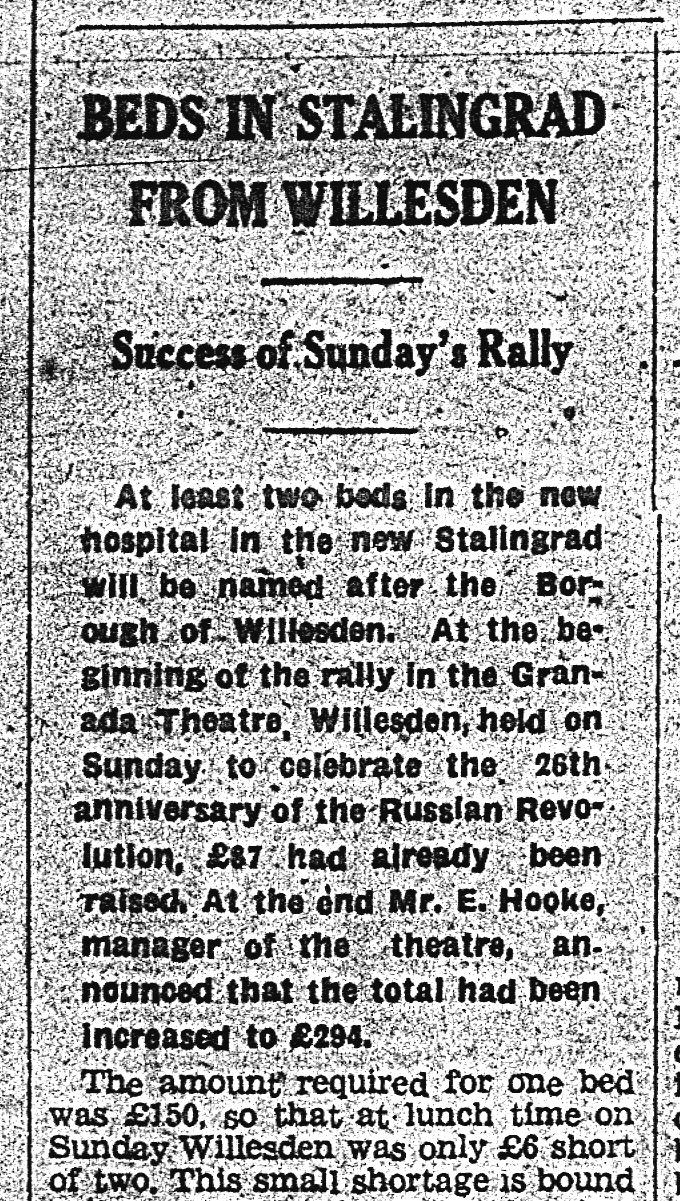
A newspaper cutting from the ‘Willesden Chronicle’ for 12th November 1943
We do not know how many Willesden beds were finally provided, or what the plaques over them said, but the inscription may have been similar to the plaque put up by Neath in Wales, which read ”TO THE GLORY OF GOD AND AS A TRIBUTE TO THE STEEL-HEARTED DEFENDERS OF STALINGRAD THE MEMORY OF WHOSE UNFLINCHING BRAVERY WILL LIVE FOR EVER.”
Posted by Malcolm
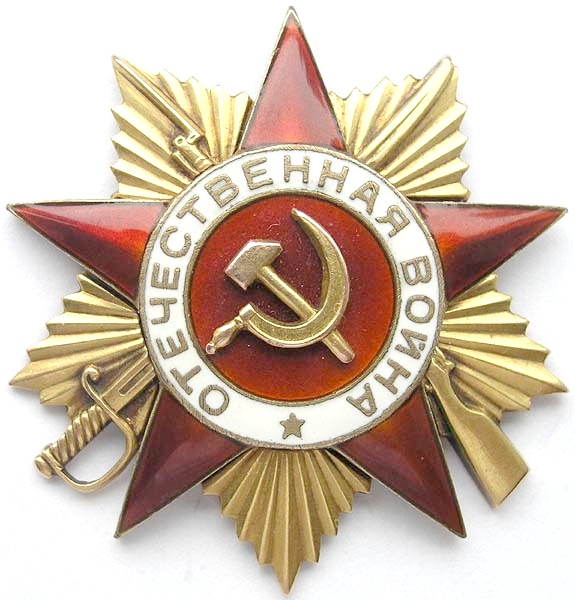 The Order of the Great Patriotic War
 brentmuseumandarchives
 Colin C.
 Emir Ghariani
NOTE: The religious reference in the Neath plaque quoted at the end may seem odd in a Soviet hospital, but there was a temporary thawing of attitudes to religion during the war. For example, the Orthodox Church raised money for the war effort, managing to raise enough to fund an entire battalion of flame-throwing T-34 tanks (see http://www.flickr.com/photos/peer_gynt/3691015095)! Malcolm