Uncovering hidden histories…
Last week, we told you about the work we’ve been doing to catalogue our film collections, and Rachel continues to find wonderful footage of local events, such as a street party held for the Queen’s Coronation in 1953 in Barretts Green Road, Harlesden, and the 1956 Willesden Show in Roundwood Park.
Cataloguing is one of the most important parts of the job for the Archives staff; by describing them in detail, anyone is able to search the collections to find the documents, maps, or photographs that they might want to look at to find out more about their local or family history. This is an ongoing task, as we receive new donations and transfers of council records all the time, and although all the collections tell their own story, sometimes we come upon something particularly intriguing…
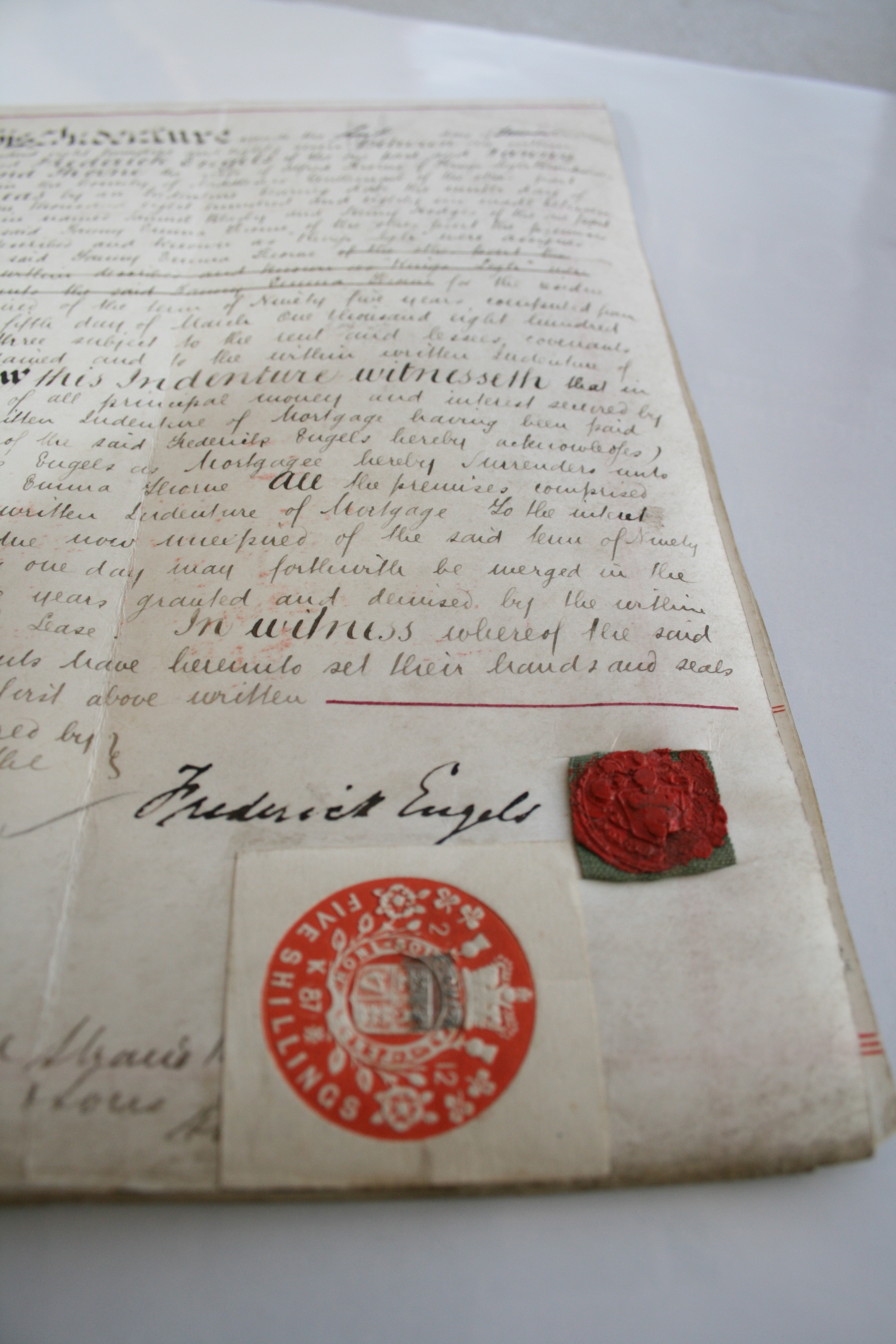
One recent discovery was a mortgage deed, one of many in the collections. At first glance, it looks like any other legal document from the 1800s; written in ink on parchment (treated animal skin, which was still used for legal documents until the 20th century). Then we noticed the name of the mortgagee – Frederick Engels, Esquire. Could this, we wondered, be Friedrich Engels, best known as joint author, with Karl Marx, of the Communist Manifesto? A little research showed that it was indeed the same man -but why was this famous advocate of collective ownership buying property in Willesden?
Today, mortgages are lent by banks and building societies, but then, they were often from one person to another. This mortgage is from Samuel Blasby, and Henry Hodges, two builders who had just built a number of properties in the area. The Willesden Building Registers, also in the Archives, show the building plans were approved a few months earlier.
The 1883 deed, for a house called ‘Kingsley’ on Willesden Lane, showed that ‘Frederick’ Engels lived at 122 Regents Park Road, which was where Fredrich Engels is known to have lived from the 1870s until his death, and when we compared the signature with other published examples, we were able to confirm that the property had indeed been mortgaged to The Communist Manifesto author. Engels was born in Barmen, Germany, and died in London in 1895. There is no record of him living in Willesden (although his lover Lizzie Burns was buried at Willesden Cemetery), so why did he acquire the property?
It seems that he may have been what we might these days call a ‘buy to let’ landlord. The mortgage was transferred 4 years later, by an addition to the original deed, to Fanny Emma Thorne, wife of Alfred Thorne of Brondesbury, who it is noted had already been leasing the property since the previous year. According to the street directories at the Archives, they continued to live at the property for at least the next 20 years.
We have been in touch with Engels’ biographer, Tristram Hunt MP, and other Engels scholars, who are just as intrigued as we are, and we hope to find out more soon about the property purchase, and whether Engels had a personal relationship with Mr and Mrs Thorne.
The stories told by the collections at Brent Archives are the history of a fascinating borough, so come down to make your own discoveries, or to find out more about how your part of the story will be preserved for the future.
Posted by Kate
 brentmuseumandarchives
 Colin C.
 Emir Ghariani